Dr. Linnea J. Smith, M.D. — Founder & Medical Director
For those of you who have asked, are asking, or will some day want to ask — what am I doing here, anyway? — here’s an approximate idea. I am a Wisconsin girl born and bred, with a few years’ time out in Kentucky and Tennessee. I went to medical school at the University of Wisconsin – Madison, graduating in 1984. I completed additional training in Internal Medicine, also in Madison, and am board-certified in that specialty. Then I went into a small group practice a few miles up the road in Prairie du Sac.

In February, 1990, I came to Peru for the first time, for what was intended to be a vacation. There was to be one week at Explorama Lodge in the rainforest, then a second week to visit Cuzco and Machu Picchu. At the end of the first week, however, I didn’t want to leave the rainforest. Even after seeing Machu Picchu and getting back home to Wisconsin, I still didn’t want to leave the rainforest. So, after some faxing and phoning and letter-writing and much patient assistance from Pam in the Explorama office, I came back to Peru, to the Explorama Yanamono Lodge, in June, 1990, armed with my stethoscope, my oto-ophthalmoscope, a small microscope, a bottle of pre-natal vitamins, a few doses of antibiotics, and a three-month leave of absence from my Wisconsin practice. I spoke no Spanish, and I knew there was no running water, electricity, nursing help, pharmacy, x-ray, respiratory therapy, medflight, etc., or etc. Explorama was kind enough to give me a discount rate on my lodging and to throw in the use of a room in one of their thatch-roofed houses for me to use as clinic space.
At the end of those first few months, it was even harder to return to my former life in Wisconsin. I therefore asked my partners for a full year’s leave of absence, and after that, simply stayed on. Explorama has arranged for my local transportation and my international communications, and been my family in Peru, ever since. I take care of their tourists when the need arises, but my main reason for being here is to help the local people, who have little other recourse for medical care.
For anyone unfamiliar with the area, the Lodge is 80 kilometers (50 miles) downriver from the city of Iquitos. There are no roads leading to or from Iquitos, so all travel is by boat. The trip to Explorama Lodge takes an hour and a half nowadays in the speedy aluminum boats that Explorama uses, but when I first arrived, we traveled in more picturesque but slower thatch-roofed wooden boats that made the downriver journey in two and a half hours, but took four hours to return upstream to the city. That’s still better than what is available to the local people — river taxis that chug along slowly and stop for anyone who wants to get on or off, taking from six to eight hours to reach Iquitos. Or one can paddle one’s dugout canoe, the local equivalent of the family car, for sixteen to eighteen hours. Needless to say, there is no ambulance service in the rainforest.
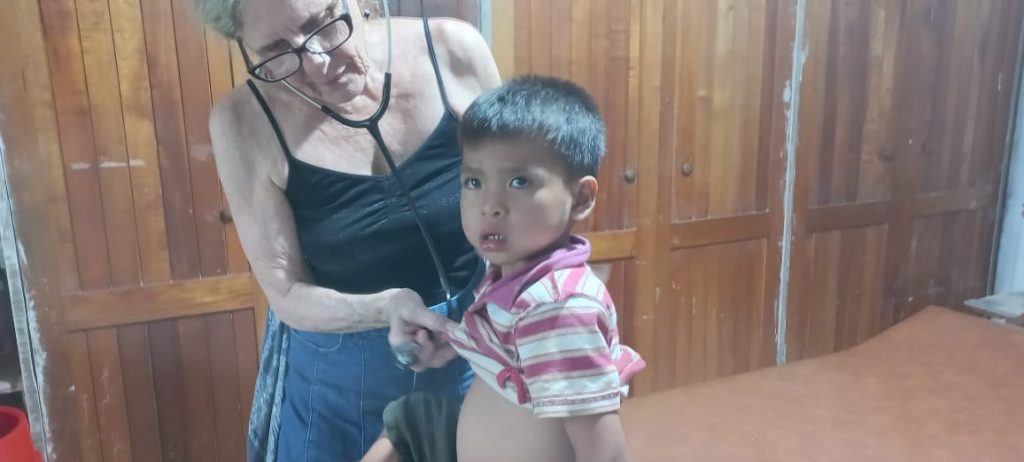
Seeing as the competition was minimal, my practice grew. By the time I was back in Wisconsin for a visit in late 1991, I was seeing about 100 patients a month, almost all of them poor, acutely ill, and with no other available source of medical care. On that visit home, I was interviewed by Jean Feraca on her Wisconsin Public Radio program. Following the broadcast, a man called the radio station and identified himself as Jon Helstrom, an architect and a member of Rotary Club, from Duluth, Minnesota. He was intrigued by what I was doing. After Jon made a preliminary visit to my rudimentary clinic, he returned to Minnesota and convinced his Rotary District to send a crew down to Peru to build a 30 by 60-foot clinic, complete with well and solar panels, on the bank of the river. While they were at it, they also built me a two-room thatch-roof house on the Lodge grounds so that I finally had my own place to stay.
The Rotary Club members who came here to build the new clinic were so taken with the people and the place that they returned several more times to amplify and improve the facility. However, by mid-2008, it was clear that the Amazon River was eating the land on which the clinic sat, at a pace that threatened to drop the clinic into the river within a very few years. Jon Helstrom was therefore consulted, and again came up not only with a floor plan for a new clinic situated on Yanamono Stream rather than on the erosion-prone main river, but also the funding and people with which to build it.
The new clinic, which opened in March, 2009, has the exam rooms, laboratory, office space, pharmacy, dental room, and patient overnight room of the original clinic; but it also boasts a comfortable living space for the doctor and nurses from Iquitos, a kitchen, and better quarters for the local clinic staff, as well as far more storage space and a much improved and expanded office.

Way back in 1992, I began training Juvencio Nuñez Pano, a local man then 22 years old, with a wife, three children, and a sixth-grade education. He proved to be an incredibly bright student, and quickly became my right-hand man, capable of examining a patient, recognizing all the diseases we commonly see, and prescribing and administering treatment. He continues to work as nurse, lab technician, dentist, and all-around engineer and fix-it man.
The clinic staff also includes his sister Edemita, who began working in May, 1995, doing laundry and secretarial chores, and soon made herself indispensable. I trained her in medical procedures, and like Juvencio, she subsequently earned a college-level nursing degree from the Universidad Nacional de la Amazonia Peruana in Iquitos. She greets and triages our patients, looks up their histories, takes their vital signs, performs her own exam, and practically grabbed the family planning program from my hands — a grandmother since she was 31, she understands the need. And when I am in Wisconsin, she manages the clinic’s purchasing and administrative chores.
As the clinic has grown, we have added first one, and then a second additional Peruvian nurse. Our current two are brothers who grew up far out on the Napo River; both are extremely accomplished, unflaggingly enthusiastic, and a great help in the clinic. As of mid-2022, we also have a laboratory technician. Then there are three watchmen-handymen-gardeners, who keep the clinic from falling apart in the humid tropical climate. And now that I am spending more time in the U.S., we have a rotating cast of Peruvian physicians.

The support that enables the clinic to continue functioning has come from a broad range of contributors. Explorama not only lets me live on their property, ride in their boats, and use their communications, but also provides the social support that keeps me in some kind of touch with my former world. Their tourists have been the primary source of funding for the clinic. The Rotarians of several cities, plus the Rotary International Foundation, raised over $35,000 for the materials for the original clinic, and nearly twice that much to construct the 2009 version, in addition to donating many hours of their labor. The Jack DeLoss Taylor Foundation has been a very generous source of support for many years, and Optimist Clubs, Lions Clubs, and various church and school groups have also provided support. The Grand Circle Foundation has also been a generous contributor. And on grounds that I don’t want to foster dependence, the patients themselves are asked for a small contribution to their own care — their payments average roughly $2.00 per person, a fraction of what it costs to treat them, and treatment is never denied to those who can’t pay.
I haven’t even counted my family, who send me moral and even financial support even though I have wandered dismayingly far from their fold; Dan and Judy Peterson, who have invested countless hours not only in managing my leftover Wisconsin affairs but also in forming the Amazon Medical Project, Inc.; Kim Stokes, who managed all our U.S. administrative tasks for over twenty years, and Melissa Traynham, who is doing that work now; and many friends who help in a myriad ways, from providing me with watercolor paints for my spare time to sending me Christmas cards to simply being friends.
That’s about it. I continue to be amazed at what has grown out of my little bag of instruments and handful of leftover vitamins.

For the first twenty years of the current century, I spent half of each year in the U.S., both for my own sanity, and in order for our local staff to learn to be more independent of me, which means I now do about as much supervising of our Peruvian staff as I do working personally with our patients. The pandemic stranded me in Wisconsin for over a year, during which we all learned to do more work remotely. In early 2022, we finally got internet service at the clinic, which helps immensely with this. The clinic staff can even send me photos of patients they are seeing, and talk with me about these patients, even when I am not physically present. Pretty amazing.
But whether I am in Peru or in Wisconsin, I feel lucky to be doing what I am doing, And I am immensely proud of our Peruvian staff and their abilities, and we will continue to provide care to the people in our locality.