Clinic Letters
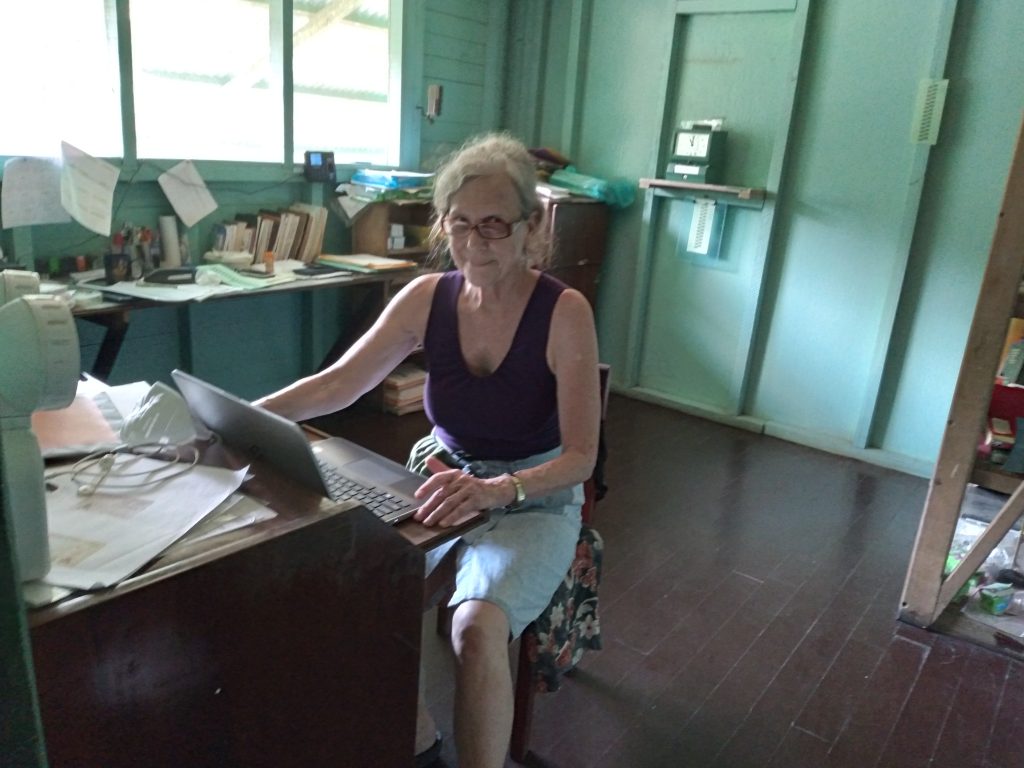
Each year, Dr. Linnea Smith writes from the clinic and from Iquitos, sharing the life of the community she has served for over 35 years. Below are her letters from 2025.
2025
01 enero 2025
I arrived Iquitos yesterday in the late morning, and Rolando was at the airport with the Explorama bus to take me to Explorama’s office. He took a lot of back routes – the streets were teeming with even more traffic than usual, as preparations for the night’s celebrations were underway all across the city. New Year’s Eve is a serious holiday in Peru.

Yellow seems to be the auspicious color. There are plenty of red and green balloons mixed in, but yellow by far predominates in the thousands of balloons swagged around doorways, hung in clusters from patio roofs, and strung in long lines outlining windows and eave lines.
At midnight I was wakened by dozens of explosions, in clusters, in single loud booms, in strings of firecrackers, set off all across the city as the new year was welcomed in, Iquitos style. The commotion continued for ten or fifteen minutes, then slackened as people returned to their drinking and dancing. I drifted back to sleep.
When I woke at dawn, the music was still going but most of the voices had given up. I went from Pam’s house to Explorama’s office, and on the street, many doors were closed, but there were still some folks sitting around a table nursing one more beer. In several places people were still dancing, with as much enthusiasm as if the night were young, which makes me conclude that either they have an amazing tolerance for alcohol, or else they partied early, got some sleep, and are now back at it. The streets are littered with hundreds (probably thousands) of empty plastic cups.
04 enero 2025, Yanamono
I am always tired when I get to the city after having been downriver, and I am always tired when I get back to the Lodge after having been in the city. After dinner, I settled in, read a bit, and crashed into slumber, waking up only a little before seven a.m. Breakfast for the Lodge employees is served at about 6:30, and they must have despaired of me, for they beat the manguare, the talking drums used to announce meal times for the tourists. I hastened to the dining room and was rewarded with breakfast, returned to my casa, brushed my teeth, grabbed my paddle, and walked to the puerto where my dugout canoe awaited.

The clinic is still officially closed for the holidays, but one of the Lodge employees had mentioned to me that his ear had been plugged for the last few days, and I told him to come to the clinic. He has a thick, bullish neck, but it looked to me as though the left side of his face was swollen, an assessment with which he agreed. He had no fever, and I couldn’t find any swollen lymph nodes, but his ear canal was irritated, the eardrum was inflamed and bulging, and there was some purulent material at the base, clearly a middle ear infection. We gave him antibiotics, instructions to apply warm compresses to the ear, and further instructions to return in a few days for re-examination.
So we’re off and running.
In the evening, when I was showering in my house, I noticed that there was movement on the inside of my shower curtain. Ants! How on earth did they come to be there? I brushed a bunch of them off and finished bathing, then picked up the small flashlight that provides illumination for the bathroom. When I shone it on the sink, where there was more activity, I could see that it wasn’t ants after all – it was hundreds of minuscule spiders. Someone’s clutch must have hatched, and all the babies were crawling around trying to get their bearings. I warned those in the sink that they had better be gone by the time I came back after supper to brush my teeth, and for the most part, they heeded the warning.
05 enero 2025
We are still officially closed, until tomorrow, and today is Sunday. However, when I arrived at the clinic this morning, I was told that there was an emergency: a woman had arrived in labor.
The subject is 26 years old and mother of one six-year-old daughter. Had this been thirty years ago, her new baby would probably have been joining five or six others.
Edemita was seated at the end of the exam table, and the new father, who looked to be about seventeen himself, was cradling his woman’s head and wiping her brow. When I examined her, her cervix was only open to about two or three cm., so we had a ways to go. Nonetheless, pretty soon, she was having contractions every two minutes, which signals that results should be forthcoming, forthwith. I dug out a pair of scrub pants and donned them.

When I returned to the exam room, I pulled the steps to the end of the table, sat down, and took a towel from Edemita. The mother-to-be was doing a great job of pushing when she had a contraction, and pretty soon the black hair of a newborn could be seen pulsing in the vaginal opening when she pushed. It did not take long before the head was emerging. I caught it carefully, then the shoulders, then the rest of the babe, small but perfect, blue but yelling lustily from the first. Her mom had predicted it would be another girl, and she was right.
07 enero 2025, martes
As I was laying in my hammock at mid-day, I felt myself sinking slowly toward the floor, to the accompaniment of soft pops above my head. The laundresses here are very fond of bleach, using it indiscriminately to attack mold and fungus, which are rife in the tropics. The problem is that bleach weakens fabric, and the tapes holding the ropes which support my hammock were giving way, one by one. Fortunately, the last few held, so I did not actually fall onto the floor. However, I took the hammock down, cut off the weakened tapes, and re-assigned the fabric to serve as a curtain in the bathroom doorway.
I added a new hammock to my Iquitos shopping list.
08 enero 2025
There is always at least some wildlife in and around the rainforest. My spider hatchlings the other day were not the last of it … a couple of days ago, as I was crossing the bridge to the dining room, an Amazon kingfisher swooped effortlessly beneath the roof over the bridge, crossed a few feet in front of me, and dived to the stream in search of a fishy breakfast. And there are always a few frogs in my house, especially around the shower. Mostly I don’t mind them much, I just consider them the canaries in the mine – if there are frogs, that makes me feel pretty secure that there are no snakes. But this morning, when I opened my front door, a frog jumped directly into my cleavage. Of course they don’t bite or sting or eat human beings, but that doesn’t prevent them from startling me. And they are kind of gooey.
I flipped him out immediately.

12 enero 2025, domingo
Sometimes, it can be difficult to find the medicines we need, such as phenytoin for a boy with epilepsy who lives nearby. If he takes the medicine every day, he does fine. If not, he has more or less continuous seizures. After asking at more than a dozen pharmacies (not even the pharmacy at the Regional Hospital had it in stock), I finally found one that carried it, and scooped up enough to treat the boy for the next six months.
However, when it came time to return to the clinic, transport proved to be elusive. Explorama had no boats going to the Lodge. So, it would be the ponguero, one of the long, narrow passenger boats which ply the river between the towns downstream and the city of Iquitos.
I arrived at the port, one of the many porters waiting on the sidewalk immediately took one of my bags and the box I was carrying and started down the steps with them, and I followed. The steps are steep but at least they were not falling apart, and were dry, and I made the boat with little difficulty. I entered, found a seat, and stowed my gear. Various cargoes were also being loaded. These included bags of bread (this boat is headed to villages downriver, and there are no bakeries in any of these), sacks of rice and sugar, cases of beer and soda, toilet paper, a few chickens, a shiny new wheel for someone’s motokar, eggs arranged in paperboard racks, stacked in batches of eight or ten racks tied together with string, and a commercially baked and decorated cake in a box – someone somewhere downriver is having a birthday or anniversary or other celebration. One man came in with an elderly woman on his back, her arms wrapped around his neck, her legs dangling down. He set her gently on her feet in the narrow aisle, and she took her seat. Then her daughter and grandkids brought her some breakfast, a newspaper, and a box of chicks which got tucked beneath her seat.
Vendors entered our boat one by one, their wares hung around their shoulders, hawking box lunches, fruit (“tremendous mangos,” claimed one, “two kilos in size!”), neck pillows, watches, chips (“great plantain chips,” assured one man, “with tons of aji” – you bought a small bag of chips, opened it, and squirted the green pepper sauce into the bag then handed the bottle of sauce back to him), chupetes (frozen fruit juice, like popsicles), toilet paper (though most women carry a wad of this tucked into their bras, since public toilets are unlikely to be stocked with this article), packets of bleach and laundry detergent (why would one need these on a trip lasting a few hours?), newspapers, sweet baked goods, etc.
Finally, everyone and their possessions were on board, the boat backed smoothly out from the dock, and we were off. It only took a little under two hours to reach Yanamono Stream.
16 enero 2025
Today I did a Pap smear on the mother of one of our young patients. The last time they were in, she had promised to let me do it on this visit, but when I brought it up, she demurred. It seems she had one years ago, and somehow got the impression that something fairly large and important was dragged out of her uterus in the process. Heaven only knows what that was about. I assured her that the test is simple and painless, and that she would leave with all her organs intact, and reluctantly, she allowed me to do the test.

Sigh. Cervical cancer is just far too common in Peru, and particularly so in Loreto, and Pap smears are a hard sell. At the moment, I am the only person in the clinic who is doing these studies, and of course I am simply not around often enough to do many of them.
February, 2025
Sometimes I wonder where I went wrong. I am now 75 years of age, and it is 35 years since I fell in love with the Peruvian rainforest and the people who live here, and I am still doing this stuff. Even when I am in Wisconsin, I am still doing this stuff.
Mid-marzo
And we just keep rolling along … yesterday there was a woman in her early 40’s who was four weeks pregnant, her last child 12 years old. She had not been using birth control because she figured at her age, not wanting to get pregnant should be good enough. She came in bleeding, and when Edemita did a pelvic exam, she reported that the cervix was wide open, and there was dark blood and clots, but no fresh blood. Her pregnancy test was negative, and her hemoglobin was normal, so she probably had miscarried. Still, she should have an ultrasound to be sure that her uterus is actually empty – if even a little of the placenta remains, she will continue to bleed.
We also emphasized that wishful thinking is not an adequate method to prevent pregnancy, and she should be using birth control if she does not wish to have yet more babies.
Mid-April 2025
Jerry and I are just back from a whirlwind trip to Peru. Among our errands was the delivery of a thermocoagulator unit to Dr. Lenin, an OB-gyn (obstetrician/gynecologist) working with Prisma, the non-profit organization which had been collecting vaginal samples from women for HPV testing.
This has been a project-in-progress for over a year. Cervical cancer, as I have mentioned before, is sadly prevalent in Peru, and especially in the rainforest. When I was a medical student, it had been noted that nuns never get cervical cancer, which makes one suspicious that the cause has something to do with men. It was then discovered that HPV, the human papilloma virus, is associated with the development of cervical cancer (it’s also to blame for rectal cancer in men, and is passed back and forth between people by sexual contact). There are multiple strains of this virus, and not all cause cancer. But by using DNA testing, one can identify the nasty strains, and it also turns out that, if a woman with one of the bad strains of HPV is treated by a relatively simple, in-office procedure, she is unlikely to develop cervical cancer later.
This is revolutionary, especially since the vaginal sample can be collected by the women themselves, eliminating the need for a Papanicolau smear, which involves removing one’s underclothes and spreading one’s legs in front of a doctor, often a male, which is a very hard sell among our patients. All last year, I took only a half dozen Pap smears; whereas we should be doing dozens.
If a woman does not show evidence of HPV on DNA testing, she does not have to do anything for five years, at which time she repeats the test. Treatment for the women with positive tests involves using a heat gun to sear the cervix and eliminate the virus, and studies have shown that it does work. Dr. Lenin says that the women he has treated describe the discomfort as being similar to menstrual cramps, and the procedure is done in an office, rather than an operating room, and is a much simpler treatment than what is necessary once cancer has actually developed.
Among the women tested in Dr. Lenin’s clinic in Iquitos, there were a number of positive tests – but Dr. Lenin’s thermocoagulator, the heat gun used to eliminate the virus, had broken down, so he was unable to do anything to help these women. However, last year, the Amazon Medical Project received a grant from the Grand Circle Foundation, to try to get this testing for our patients. We were able to use some of this money to purchase a thermocoagulator, and delivered it to Dr. Lenin, who was ecstatic at being finally able to treat the women who have been diagnosed with pre-cancer.

When I was in Iquitos, I went with Monica to the Puesto de Salud Progreso, where Dr. Lenin works. A beaming nurse midwife swooped down on us, having recognized me from a photo Dr. Lenin had taken when I delivered the new thermocoagulator unit to him, and insisted we come to her small and crowded office across the hall, where she told us how welcome that little machine was. She was effusive in her thanks, and radiant with joy at being finally able to treat these women. So, there are now a whole bunch of women who are receiving treatment that will save them from developing (and dying of) cervical cancer. They aren’t exactly our own patients, but they are our neighbors, and it was immensely gratifying to know that after so many months of frustrating efforts, some very concrete good is being done thanks to that wonderful grant from Grand Circle Foundation.
And now we have gotten some of the test kits, so the women in our neighborhood will soon be able to test for HPV, and Dr. Lenin has most graciously offered to come to the clinic to provide treatment to those who need it, thus saving the women the expense and effort of having to go to Iquitos.
Late junio 2025
You have to love Iquitos. Despite being a city with a population which must be nearing half a million people, it is still a small town, or at least a collection of neighborhoods.
One morning, I left Pam’s house to head for Explorama’s office, and had gotten as far as the corner when two motokars approached me. I caught the eye of the first one, and he pulled over to the side so the other one could pass and he could cross the street to pick me up. As the second driver passed, he said to the first, “Explorama está yendo” – “she’s going to Explorama.”
Downriver at the clinic, the river was back within its banks, but barely. This year’s flood set no new records, but the water at my house and at the clinic had been more than knee-deep. And the inundation was persistent. Normally, the river is constantly rising or falling. The water level almost never stands still. Yet this year, the river remained at its peak, with very little variation, for a full month, allowing all the silt it was carrying to settle onto the ground. Now that the water was receding, what was left behind was mud, or actually, more like slop. Mud Season is worse than flood season in the Amazon, in my experience.
I opened my house, which Ari had conscientiously cleaned and mopped, and began sorting my bags. There was a plastic laundry tub containing an assortment of items which had been laundered and left in the house for my return. But when I started to sort through the tub, it was obvious that mice had been at work. There was a mess of chewed materials, some of which I recognized as remnants of the contents of the tub, others which were vegetable matter. Sturm und drang, as Jerry’s German grandma would have said – there’s a mouse in my house. I pulled out one curtain, only to find several large holes gnawed through it. Then there was movement, and a very startled, very large mouse gawped up at me. Blah! I exclaimed, as I think did he. I grabbed the tub, and while he raced frantically around the inside upper edge, I carried the whole thing to the front door, and ungraciously threw him out into the mud.

I pulled out my hammock, and it was worse. Blast it, I just bought this hammock in April. Evidently the fabric, which was a soft cotton, was irresistible to rodent appetites, and the cords by which the hammock is hung were in even worse shape. As I was commiserating with myself for the loss, another small gray head poked up out of the mess. They were a pair, and were undoubtedly about to populate my poor house with a brood of new rodents.
I again hastened to the front door and tossed the remaining partner, then went back to the tub to pull everything out, one piece at a time. They had gnawed holes in a couple of my curtains, pretty much destroyed the hammock, and eaten more holes in my favorite long-sleeve shirt.
Well, the hammock could be replaced. I mourned the shirt, which I really liked, and which had a pocket that I had sewn on by hand. And I was not that crazy about the holes in my curtains. Ok, I made them back in 1993 when the house was new, and they have been fraying anyway. All the same, I am not ready to let them go. At least I evicted the beasts before they could reproduce.
We are moving ahead on HPV testing, which is going to be a revolutionary step forward.
We were able to test a dozen or so women, and can confidently reassure those who tested negative that they shouldn’t have to worry for another five years. The first one was in the clinic yesterday, and thanked me profusely – she had had an equivocal Pap smear early in the year and had been worrying for months that she was about to develop cancer. Her relief at testing negative was palpable.
We have five or six women who tested positive for the bad strains of HPV. This does not mean that they will necessarily develop cervical cancer down the road, but it does mean they are at risk for this disease, which unlike in developed countries is frequently fatal due to women’s hesitation in seeking treatment, and the difficulties and barriers to receiving such treatment even if they do try.
Dr. Lenin and Karina had agreed to come to the clinic to treat our patients on-site. We had given them a thermocoagulator unit to replace theirs, which had broken down. Then another donor, who wishes to remain anonymous, gave us another unit that we can use in the clinic. We just have to learn how to do so.
The procedure itself is simple. One does a pelvic exam using a vaginal speculum, looking directly at the cervix. Household vinegar is then applied to the cervix, which may turn white if there is already damage done by the virus. Even if not, the woman merits treatment because she has been shown to have the HPV virus in her body. Through the speculum, one inserts a sort of pistol-shaped tool, and applies it to the surface of the cervix. This device then heats up against the infected surface, which later will slough off, carrying the nasty virus with it.
Dr. Lenin and Karina set up the exam room, and we got out the necessary instruments and materials. Karina gathered all the women, plus one husband who had accompanied his wife, in the patient overnight room, and we all sat on the beds and she explained everything once again.

Then we set to work. Dr. Lenin did a brief interview with each woman, confirming their ages, gestational histories, and the absence of any concurrent illness. Then he performed a vaginal exam, did the acetic acid testing, then applied the heat gun, while Karina held the women’s hands and distracted them with conversations about their children and families and lives. Most of the women stated afterward that they had little or no discomfort. Only one woman grimaced fiercely and was obviously in considerable discomfort during the procedure, and Dr. Lenin later explained that this was far more common in women who had not had the chance to hear the pre-procedure talk (she had been a late arrival). Even so, she was pretty much back to normal and was smiling again a few minutes after completing the treatment.
We will get more of the tests, and Dr. Hamlet will practice with Dr. Lenin and Karina at their medical post in Iquitos, so that he will be qualified to do the treatment in our clinic.
Julio 2025
Since we finally got the coveted Convenio (formal agreement) with the government, we have again been able to acquire vaccines, and now that we have them, we need to take good care of them. However, our trusty but aging vaccine refrigerator has been leaking black goo onto the floor for some time now, and its door seals are wearing out. And Edemita tells me that the base of the fridge is slowly rotting away. Maybe that’s the black goo.
At any rate, I ordered a new machine. This is a different model than what we have had. It sits on the floor, and you lift the lid on top and enter it from above. It is more expensive than the old one, but then, everything is more costly than it was a dozen years ago. It would come from Lima, and the price included a technician who would install it and give us an orientation on how to manage it. Including the wooden crate built around it for shipping, the beast measured just about one cubic meter, and weighed 111 kg (about 250 pounds). This would be a large item to haul down many steps to the boat which would take it downriver. I had visions of it tumbling head over heels, down the steps, and diving into the river.
But Ervi, head of Explorama’s storeroom, assured me they are capable of handling items of this size. I expected it would take four or five sturdy laborers to haul the refrigerator down the many steps from Explorama’s garage to the boat dock, but as it turned out, one man, with a tump line around his forehead, tilted it off the truck onto his back and hauled it down all the steps to the floating dock, without slipping or stumbling once. We then loaded it onto the cargo boat and brought it to the clinic.

We also brought an electrician to give us a breaker box at the clinic. Since the clinic was built, all lights, outlets, etc., have been on one circuit, and we really should have a separate circuit for the exam rooms and lab, another for lights, another for outlets, and of course an independent circuit for the new vaccine refrigerator. The electrician came, along with his son, and over two days they checked everything over, tucked the loose wires into conduits, and left us with a breaker box, with separate circuits as outlined above.
The new refrigerator now sits proudly in the pharmacy, looking extremely sturdy and well-built, and we will soon stock it with vaccines.
There was also the matter of the jaguar.
Some of the tourists had been talking with a local man who has been on night watchman duty around the Lodge, and they said he had reported sighting a jaguar in the forest, not far from the Lodge. That is certainly not impossible, but it seemed unlikely, so I talked with him myself. Had he really seen an otorongo, I asked? He appeared startled, and said, oh no. What was it, then?
His speech is a little muffled, partly due to several missing teeth and partly due to his way of speaking, but it sounded like he said it was a bulto. A bulto? I asked. What sort of animal is this? He seemed a bit flummoxed. Is it like a cat, or a bird, or what? He repeated that it was a bulto, and indicated that it was about waist high. Then he seemed to say that it had come down out of a tree, and then it grew until it was quite a bit larger, and then it sort of exploded in a flash of light.
By now I was pretty sure it was not an animal that would be found in a zoo. Was it sort of like a tunshi? I asked (the tunshi is a ghost spirit that wanders the night), and he agreed, yes, kind of like that.
Golbert confirmed it … the bulto, as he said, is a variety of mystical animal. So, we don’t need to worry about running across a jaguar in our evening rambles.
31 octubre 2025
On Thursday, Dr. Hamlet and I went to the medical post at Progreso to practice the thermocoagulation treatment that is given to the women who have tested positive for HPV. There were eight women to be treated, and after Dr. Lenin took care of the first two, Hamlet got to providereatment for the remaining six. I’ll have my turn later.
02 noviembre 2025
This morning there are a gang of squirrel monkeys helping themselves to the bananas hung for them outside the dining room. There are several kinds of monkeys around here, but the most common are the frayles, the squirrel monkeys, about the size of a small cat. They roam in large gangs and don’t make much noise. When I hear the sound of branches bouncing as first one monkey, then another, lands and immediately leaps off for the next branch, I know it’s the squirrel monkeys. The other common ones are the saddle-back tamarins, which are a little smaller, have different coloration, travel in smaller groups, chatter a lot among themselves, and scold me noisily whenever they notice me looking at them.
After the monkeys had gotten their bananas and melted back into the forest, a blue morpho butterfly, larger than my hand, shimmered through in its irregular flight pattern, its iridescent cobalt-colored wings flashing in the sunlight.
No wonder I like the rainforest.